 X
X
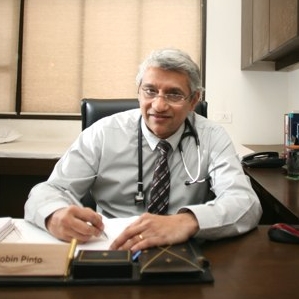
DR ROBIN PINTO
Cardiologist
Introduction
Dr Robin Pinto has a vast experience of 30 years during which he has treated a large number of congenital and acquired heart disease patients. His special interest is Paediatric Cardiology (both echocardiographic evaluation and intervention). He is actively involved in transcatheter closure of congenital heart defects such as ASDs, PDAs and even a few VSDs. He also specialises in adult Coronary Angiography and Coronary Angioplasty by the transradial route. This is performed by just a few doctors and is advantageous to the patient as well as institution, as patient discharge is possible soon after the procedure is performed.
Hospital Associations
Lilavati Hospital And Research Centre, Breach Candy, Holy Family Hospital
Services/Interest
- Pediatric Cardiology
- Abdominal Aortic Aneurysm
- Angina Pectoris
- Arrhythmia
- Atherosclerosis
- Cardiomyopathy
- Coronary Artery Disease
- Heart Failure
- Hypertension
- Myocardial Infarction
- Peripheral Artery Disease
Experience
Dr. Robin Pinto joined the Department of Cardiology at KEM Hospital, Mumbai, in August 1988 as registrar. Over the next two years, he gained experience in the CCU (including Invasive Hemodynamic Monitoring), Non-Invasive Laboratory, Cardiac Catheterisation Laboratory and Paediatric Cardiology. Training at this major referral center gave him an opportunity to work up and treat a large number of congenital and acquired heart disease patients. These included cases of Coronary Artery Disease, Pericardial (especially Tubercular), Myocardial (Cardiomyopathies including EMF) and Vascular Disease (including a significant number of cases of Aortoarteritis). Thereafter Dr. Pinto worked under Dr. Satyavan Sharma in the capacity of Lecturer in Cardiology at B Y L Nair Hospital and later as Senior Clinical Assistant in Cardiology at Bombay Hospital. He became actively involved in the Interventional Cardiology Program and thereby gained vast experience in Coronary Angioplasty and Balloon Valvuloplasty. In the year 2000, Dr. Pinto obtained special training in Paediatric Cardiology at the Gaslini Institute in Genoa, Italy, over a period of four months.
Awards and Recognitions
National Council of Educational Research and Training (National Talent Search Unit) Scholarship 1977. National Scholarship Scheme 1978. Ratanshaw Dadabhoy Scholarship 1983. R S Poredi Gold Medal. (1st in Medicine, University of Bombay) 1983. Dr. Keikushroo Sorabji Kanga Scholarship (University of Bombay) 1983. Dr. Govind Vishnu Juvekar Prize (University of Bombay) 1983. Dr. P F Soonawala Prize (University of Bombay) 1983. Shri Kund. Gordhandas Bhalja Prize (University of Bombay) 1983. Krihnaji Hari Datey & Dr. K K Datey Prize 1983. K W Dani Memorial Prize 1983. Distinction in Physiology & Biochemistry at the First MBBS Examination. Distinction in Anatomy at the First MBBS Examination. Distinction in Pathology at the Second MBBS Examination. Distinction in Medicine & Therapeutics at the Third MBBS Examination. First in Bombay University in Medicine & Therapeutics at the Third MBBS Examination. Second in Bombay University in Cardiology at the DM Cardiology Examination.Dr. Robin Pinto has a large number of publications to his name and has frequently presented papers at national and international medical conferences.
I Speak
English, Hindi
Feedback For Dr Robin Pinto
Write FeedbackWho is a cardiologist?
A cardiologist is a trained medical professional with special training and skill in finding, treating and preventing diseases of the heart and blood vessels, which is the cardiovascular system.
Cardiology is a complex field, so cardiologists specialize in different areas. All cardiologists are clinical cardiologists as they focus on the diagnosis, medical management, and prevention of cardiovascular disease. Some clinical cardiologists specialize in pediatric cardiology, so they also diagnose and treat heart problems in children. An adult cardiologist is the clinical cardiologists who treat only adult patients. Other clinical cardiologists who specialize in interventional procedures like angiography, angioplasty, stenting, and TAVI are called the interventional cardiologist.
Why should I see a cardiologist?
With statistics like heart disease being among the number one killers, there is no reason for anyone to not to be worried. General cardiologists are practitioners that focus on the heart, so If you are at risk for heart disease, a routine check-up with a cardiologist can help you to be on top of your heart health.
And in case you are wondering how to be sure that you are at risk for heart disease, then you can look at the certain common symptoms shown by your body that usually point to heart disease. Whenever you feel chest pain that is radiating towards the left side or to the back of your body, you should immediately consult an experienced cardiologist. You should also consult a heart doctor when you experience severe pressure in the chest, shortness of breath while walking and continues while you are at rest, Irregular heartbeats leading to palpitations, sudden clenching pain in jaws, or when you undergo excessive sweating continuously for a long period of time without any exercise.
What kind of tests do cardiologists do?
Cardiologists perform the following tests:
- Cardiac CT scan,
- Magnetic resonance angiography (MRA) of the heart,
- Electrocardiogram (ECG),
- Stress test (also called treadmill or exercise ECG),
- Echocardiogram,
- Magnetic resonance imaging (MRI) of the heart,
- Cardiac catheterization,
- Electrophysiology study,
- Tilt table test,
- Loop Recorder,
- Transesophageal echocardiogram (TEE),
- Positron emission tomography (PET) scan, etc.
How often should you get your heart checked?
You should get your heart checked as often as possible, and this is especially true when your family has a risk for heart disease. You should get your blood pressure checked every year, and according to the American Heart Association, the screening tests for coronary artery disease should begin at age 20, cholesterol test at age of 25, and blood glucose screening should begin at age 45.
Is there a difference between a cardiologist and a cardiac surgeon?
Cardiologists are doctors who specialize in cardiovascular disease and are able to treat conditions ranging from severe hypertension to elevated cholesterol to heart rhythm problems. Cardiologists also are able to perform procedures that both help diagnose and treat many cardiac conditions, for example, cardiologists can perform stress tests to uncover coronary disease, conduct echocardiograms to diagnose holes in the heart or other issues with heart valves; they may even order monitoring of the heart to uncover rhythm issues like atrial fibrillation. In addition, to treat these specific problems, specialized cardiologists like Interventional cardiologists can close small holes in the heart, place stents in clogged arteries, and place specialized devices in the heart. Cardiac surgeons come from a very different background and are usually the general surgeons who chose to further specialize as cardiac surgeons and limit their practice to the heart arteries and heart valves.
Do you see a cardiologist for high blood pressure?
If you test on the high side for blood pressure and yet your regular doctor says you're blood pressure is controllable, you could still benefit from seeing a preventive cardiologist. Preventive cardiologists are a special type of clinical cardiologists whose goal is to prevent cardiovascular diseases and to reduce the burden of them in populations and improve the quality of life and life expectancy in individuals with such diseases.
What happens in a cardiologist appointment?
In your first cardiologist appointment, you are usually greeted by a member of the nursing staff who measures your weight and height in order to calculate your body mass
(BMI). At this stage, you are normally asked to go for one of the following tests:
- Electrocardiography (ECG) which is a tracing of the heart carried out by attaching leads
- Echocardiograph (ECHO), a scan of the heart.
- Both of these tests are simple and painless.